Showing posts with label "Rachel Hill". Show all posts

Monday, February 15, 2010

Going Once, Going Twice, Public Pedestrian Street SOLD to the highest bidder.

Protesting students having a drink after their "shift" in the container, pre-container demolition.


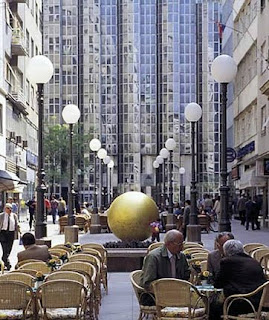
Back in the day women used to come to Cvijetni Trg (Flower Square) to sell their, well, obviously, flowers. There were hand pumps for water and a beautiful, small Orthodox church flanks the square to the north. Pedestrian corridors radiate from the square, connecting to Ilica Ulica, a big commercial street and tram line while a network of small passages connect under and through the surrounding buildings. The “sun”, a huge metal ball representing the center of the universe sits in the middle of one connector pedestrian street and small specks of metal have been cemented onto buildings around town representing, to scale, the universe in Zagreb. Mercury is in the old upper town. Pluto is beyond the last tram stop to the west. This central square is marked as such both symbolically with the “sun” (see image below) and physically in its proximity to almost everything in downtown Zagreb. There used to be large, old trees but at some point a “modernization” effort removed the old hand pumps, newly paved the square and took down the old trees. People protested but their voices seemed to resonate like TV fuzz in the background and were easily tuned out. Numerous people have said that the “renovation” of Flower Square was the biggest architectural mistake in Zagreb (this is saying a lot in a town that destroyed 500 year old fortress walls surrounding the cathedral to create open space that turned into a car turn-around and demolished a medieval neighborhood so that they could move the market from the main square to someplace less dignified and fitting of the provincial Dolac market). An old factory sat on one edge of the square where chairs are set up in thick clusters like hundreds of living room arrangements gathered around tiny tables for coffee and beer. The building was over a hundred years old when it was sold to a private developer with visions of shopping malls dancing in his head. The omnipresent shopping malls in Zagreb feel like the shopping malls in LA, Berlin or Milwaukee – they have the same stores and the same layout, facing inward along the “streets” of tile and escalators that create cloned indoor cities across the world with the result of homogenizing people and stripping away any distinctive character that a place may have. Since it was just reported that over 300,000 Croatians are unemployed, I am not sure who will be patronizing this new mall. Zagreb citizens protested and while the discussion went on in city offices, the factory was bulldozed and VIP Telecommunications was sold the advertising space on the scaffolding surrounding the new pit which they promptly covered in a flashy poster of a woman’s legs, 25 meters tall, waltzing with her cell phone. You’d think that the citizens of Zagreb may be deterred or discouraged but they remain ever vigilant because they know that the buck doesn’t stop with honored public space and traditional livelihoods like the flower vendors. The 150 year old factory was simply a remnant of a socialist history that the powers-that-be in Zagreb would rather bulldoze into the past. This is how Croatian cities are formed and reformed, you see. Politics and influence are constantly flexing, responding, defining themselves and redefining themselves. Last night I got into a conversation with a bunch of Croat friends about Coca-Cola versus Pepsi during which one friend gave me an animated lecture about the politics surrounding both brands and the soap box that you stand on when you chose to drink one over the other. Regardless of whether he had his facts straight about soda pop, every choice made in this country by Croatians is made to make or erase a point. And the situation of truth is relative. Drinking Pepsi is a statement against “fascist bastards” (according to this friend) and tearing down the old factory is a statement of progression into the modern capitalist world that Croatia is trying so hard to gain respect in (they are rushing the EU right now and they are trying to be the best darned European nation they can be). Well, I’ve got news for you, the powers-that-be in Zagreb: you can’t sell off your history and you can’t ignore the voices of the public because they own that land as well as those streets lined with cafes and stores. Those little conduits where the public musicians play guitars by the big “sun” – that belongs to them too.
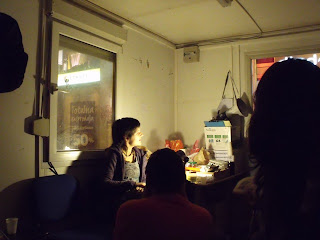

left: inside the container on a peaceful night.


But here’s the kicker. A week ago I went down to meet the boyfriend of a friend who is part of a student protest on Flower Square. The City didn’t stop at demolishing the factory. The developer decided to put in high-end condominiums and wanted private parking for his residents’ BMWs and Mercedes. He asked the city for a little favor – could he please have one small pedestrian street connected to Flower Square. He wants to put in a parking garage with close proximity to the condos. The City of Zagreb acquiesced, perhaps even willingly since I’m sure this developer is paying a pretty penny. Students and citizens set up “containers”, the box-like structures often put semi-permanently on construction sites. They filled the containers with protesters around the clock who smoked cigarettes, chatted and watched the police in their SmartCars zip around the square monitoring their activities. A British-Croatian girl had hunkered down for the long haul, in her sleeping bag, explaining to me that although the decision to turn this street into a private parking garage would go through a public process, the public really had no forum for participating in the discussion. These containers were their “letter to the Mayor”. They were their chance to stand at the microphone before Mayor and Council and be heard.


I left Zagreb to come to Vis for my research for a week. Sitting in the kitchen of my friend Dini, he turned on the television and to my horror, the national news showed the Special Police (in full riot gear) tearing down the containers and crawling over the edges into them to pull out the protesters like flopping fish from the ocean. It was dark and the entire scene looked like an overly dramatic movie. There are so many things I find uncomfortable/despicable about this situation. I am sad to predict that the reason the Special Police were used (at night, in large numbers) appears to be part of the manipulative drama that portrays the protesters in a dark and unruly light in an attempt to influence public opinion towards what seems to be another inevitable mistake in public space appropriation and use. This is just my hypothesis. But I don’t think it’ll work. I think the citizens of Zagreb know exactly what is happening. I don’t have my ear close enough to the ground to know if it will matter, if the majority of citizens will be apathetic, feel they don’t have any power, or see this as yet another inevitable case of corruption lining the pockets of the powerful… or whether the Croatian collective psychology that seems to find power when there is a reason to coalesce against something will continue to protest. I leave for Zagreb today. I’ll keep you updated.


left: the pedestrian street leading to the Trg (square) that is slated to become a parking garage.

Thursday, January 28, 2010

The Big Trg - the honey pot


Once upon a time there was a little girl named Medva. She lived in the mountains. One day she wandered down the mountain and met a tired bear. He was sitting on a rock and as she approached he looked up anxiously. “Honey, I am thirsty. Do you have some water?”. She didn’t have any water. But she knew of a secret spring – the Medveščak stream. It came up from the ground not far from where he was sitting. She brought him to the spring and he drank and it saved his life. Forever after that day, this spring was sacred. By sacred, I also mean “fought over”. It divided two parts of the city, ran mills, flooded and drowned people, earning a bridge over it the name “Bloody Bridge”. Then, in 1898, the powers-that-be decided to cover the spring and turn it into part of the sewer system (makes sense, doesn’t it?). By this time the people had built trams around the old spring and a big statue of Ban Jelačić stood in the middle. It was built by Austria in 1866, facing north with his sword raised towards Hungary. A while later, after a great war, a man named Tito came along. He said that the old story was hogwash and bricked over the sacred spring. People were sad but they looked towards the great man and said, “if you say so”. The big Ban statue was removed by the Communists in 1947 since it commemorated collaboration with the Austrians (who collaborated with the Germans who collaborated with the Ustasha who persecuted Serbs, Jews, Gypsies and Communists. In a much more impacting and terrible way, it was like highschool). Then one day, Tito died. Tall buildings towered over the bricked-over spring. The summers were hot and the outdoor cafes, filled with people smoking slim cigarettes, yearned for the quenching spring. In 1990, the new leaders were saying “you know what, perhaps that talking bear was OK… because you know, he was a Croatian talking bear. Let’s bring the statue back (but face him south), open up that spring and tell our children the folk story. Then let’s declare our independence and be as we always should have been, an independent Croatia”.

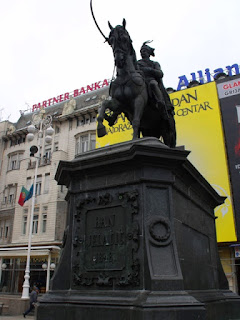
Image below: Ban Jelačić defending Partner Banka, Mikla Chocolates, Vip Cellular and Loreal.


I am sure to have many details of that story wrong. I heard it over beers at a Cinkuši concert – a “modern traditional” Croatian band from the region to the north of the city. The crowd was young and hip, some having dreads, leggy women in slinky dresses, but they were swaying with beer glasses held high, chanting the traditional music as their great-grandparents would have. I remember the woman translating the story into English was stumbling along – her English was rocky – and when she said, in a thick Slavic accent “Honey, I am thirsty”, her colloquialism cracked me up. “But you see, bears like honey”, she said. “Of course!”. The roots of Winnie the Poo may have come all the way from Medvenica, the mountain above Zagreb with the talking, honey-lusting, thirsty bear.
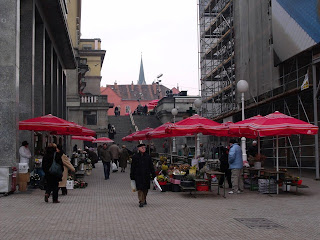
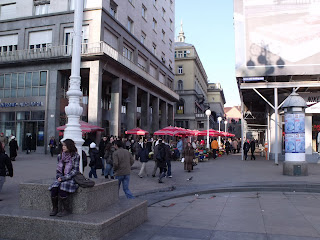
Images above: Giggling Croatian teenagers in the Trg; the staggered clock tower in the distance, the Ban in the center and the fountain in the foregroundpast the flower sellers, up the stairs to the Dolac market.
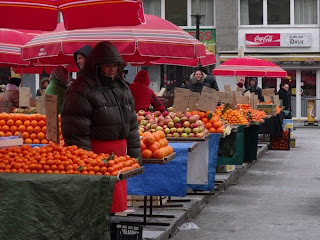
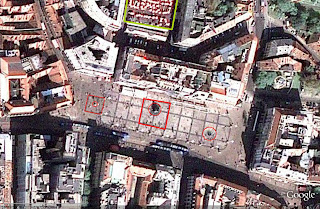
But the gist of the story stuck in my mind. It put a new spin on the Jelačića Trg (Jelačića Square), the most important public space in Zagreb. It is a clumsily designed square if you ask me. It’s a rectangle at the foot of the old town. Above it, past lovely, wide steps is the Dolac, the main city market that overflows with rural farmers selling produce, home-made cheese, honey, hand-knit caps, traditional cloth, and dried figs. Around the Dolacs are small shops with tables you can stand next to and eat chevapi, little meat sausages in fried bread. A girl runs around bringing cups of coffee to the vendors, many of whom are old, weathered and bundled head to toe in coats and scarves, selling their produce as they have their entire lives. And as you walk down the steps and the vista opens up to Jelačića Trg, flower vendors line the passage. No joke. It’s like you are walking down the isle to the alter every time you enter the square, with the scent of flowers on either side and rose petals scattered on the herring bone stone pavement. Aerial below: Jelačić is in the center red square, the clock on the left/west side and the fountain on the right/east side. The green square is the Dolac market; the fountain on a cold day.
So this fantastic market flanks the square to the north. Ilica Street, the most bustling commercial street in the city runs along the south side of the square, the main artery pumping people in and out. Every tram line passes through Jelačića Trg. Which means huge crowds gather around the tram line. This brings newspaper vendors, the man hawking small bracelets, the Roma women with random articles of clothing, the fancy Italian business woman, the crowds of smooching and giggling Croatian students. It’s jam packed. But just above the tram line is the other clumsy element of the square, a small, out of scale clock that stands on the other side of the big statue of the old Ban. It’s modern in style but awkward, like an Ikea afterthought in a college dorm room. It seems cheap but utilitarian. But it does its job. It was stuck there to, I assume, inform travelers of the time. Just like the blocks of socialist era housing on the south side of town, built to house the workers, pure and simple, this clock tells the time, pure and simple. Even though it has none of the class and sophistication of the old clocks found in train stations and on towers in the centers of other great cities, I’ve met every “coffee date” under the clock in Jelačića. It’s pedestal is constantly surrounded by a group of people waiting for someone else. So regardless of my nose-in-the-air opinions on its awkwardness, it works and people love it.

I’ve been here for three weeks and talked to many Croatian architects and landscape architects. I’ve asked many of them about their opinions on the “Big Trg”. And every single one of them defends it so quickly that you learn shut up and admire its vitality over its design. But this may be the reason why it looks as it does and why people love it so. It is an amalgamation of all the little things, here and there in Croatian history that make the people who they are. It’s a folk story that roots them in the ancient forests, it’s a reminder of the socialist ideological leader who ‘knew best’ and the rebellion when folks decided they wanted their folk story back. It’s the old “Ban” (leader from Austro-Hungarian times) and a placard to modernity with all the big Croatian companies advertising phones, banks, make-up and technology on scaffolding around the buildings lining the square.

Monday, January 18, 2010

What do we do? Can you sum it up in a sentence?

Zagreb. So much to say about this place – it’s urban-ness, its parks, even parking is worth a couple photos (so I'll stick a couple photos in). But what I find myself confused by and thinking about most often is my inability to describe/circumscribe my profession in this country. People don’t get it and I started to find myself confused. There are only 30 registered landscape architects in ALL of Croatia, if that helps you to understand why people don’t know what we do. The academic program is new at the University and began under the instruction of Slovenian landscape architects. I am not sure why it got its own designation in Slovenia but has only slowly and recently trickled into Croatia.

I had an interesting short conversation with a Croatian architect this week. He is a friend of my roommate and with one hand in the pocket of his black suit, after an explanation of what the “fancy” people in Zagreb do in their summers, he said that “landscape architecture” is shared between the Agriculture and Architecture departments at the University of Zagreb but “not respected by either”. At first I felt my feelings were a bit hurt. Then I felt as if I needed to explain, to defend my profession. I didn’t. I let the comment pass and thought about it the next day as I walked around the city.
(Smart Cars: created to make their own rules about parking in old town Zagreb - first image. Even though it's not an ideal solution, cars get squeezed into old town streets, two wheels up on the old sidewalk, their butt in the street. New Zagreb has taken care of this problem with oceans of parking sandwiched between the roads and the buildings - second image)


The designed environment is so obviously in your face all over European cities and Zagreb is no exception. But architects design buildings (and their plazas) and engineers design tram lines, according to the architect I talked to. Gardens are seen as frivolous here in Croatia because the recent war, the thousands of refugees and a depressed economy makes people worry about food and security. Parks were often designed hundreds of years ago on the property of rich land owners, often for their private use, appropriated by the public later on when the cities grew around them. One thing I want to point out though, is that Croatia has great “bones” for good public, open space even if it doesn’t have the money currently to keep it up. The plaza in front of the Zagreb Cathedral has much to be desired. It is essentially a concrete car turn-around sandwiched between a Baroque fountain and the impressive façade of the Cathedral. It hardly looks designed (although maybe at one point it was). The square in front of another notable church is used for parking for the Sabor (the Parliment). And Trg Ban Jelacica, the main square is a big and well used rectangular space full of people, trams and activity. In the center is an ostentatious statue of the Ban himself, on a horse. At least fits in scale to the huge space. Flanking him is a pitiful, modern-esque clock and a poorly placed, small, sunken fountain. The beautiful, tall, old buildings surrounding the square are covered in Zip and T-Mobil advertisements from the ground to floor 6. But in contrast to some of our most well-designed and thoughtfully designed spaces in the US that hardly get a lunch-time passerby, these places are hopping. In terms of the design of public space, whether someone did it on purpose or not, back in the day, they did it right.

(Ban Josip Jelacic Square - the statue and the advertisements show what was and what is important)


Now travel out to Novi Zagreb, the new part of town. You get all the crud that you get in the US – huge arterials filled with cars around (a somewhat uniquely Communist element) huge apartment buildings with clothes lines hanging out windows, parking surrounding them like a tree skirt and grafitti covering the ground floor. It reminded me of the plans that Corbusier had for a re-built Paris. This part of Zagreb felt sad. Of course, the war was a terrible thing for Croatia but this landscape of sullen buildings in a web of streets and parking lots made it seem like “landscape architecture” or at least what it could offer the people living in post-war Croatia may be a very un-frivolous endeavor.

In an office in Novi Zagreb I met the director of Oikon Ltd. and one of the few registered landscape architects, Hatec and Visna. Hatec, came to introduce himself and talk a bit about the COAST Project, the project off which I am hoping to work. Vis, my island of study, is part of COAST. Quickly Hatec began talking about the difference between American and Croatian perspectives on landscape architecture. It’s not about pretty gardens or even nice parks, he said. “We have had war in this century. You (Americans) have not, at least not on your own soil, since the Civil War”. He began analyzing the Civil War to make the point that during the Civil War, soldiers fought and died but it didn’t involved civilians and villages. I didn’t believe this to be completely correct but since he was on a roll, I didn’t stop him. My blood pressure did begin to rise, however. Then my internal psychologist reminded me that part of this process is being “that person”, the foreigner, and listening and understanding the point of view that comes out, provoked by people who are “not from here”. This is an important dynamic on Vis, an island steeped in "island syndrome", suspicion of foreigners and a desire to keep life as they know it, far from the grasps of those who aren't like them.

Hatec said that perpetual war has impoverished this country. The one-party government was a supervising and regulatory government. This role was not enabling and did not seek to grow knowledge but to contain what it felt was not correct and needed reigning-in or controlling. The government saw themselves as “bosses” not looking for active participation and partnership. This, as Hatec explained, was not a healthy process but an imposed one. Implementation occurred when the government went to University professors with ideas and asked them to back them up with their knowledge instead of education and discovery informing government creating progress. The process was backwards but that’s how it worked. After the Civil War comment and the shell I was ready to hold up to deflect the “you-just-don’t-get-it” comments, these points were salient.

How does this apply to Vis? In Croatia (said to compare it to the USA), “we care about what is old not what is new”. A conversation about the new-ness of American communities and an assumption that Americans love brand-spankin’ newness above all else that is holy, in contrast to the Croatian mentality began. I succinctly retorted that many Americans place great value in what is considered old, traditional and important to history. Our history may seem less “deep” (in age) than in Europe however it is no less revered (and in fact, just as old depending on the measure of it and the societies you are considering). The “newness” bug has more to do with the ability for expansion to happen so easily in the US. We had and still seem to have so much space… so we keep consuming it! I wanted to remind him that his office sat in “Novi Zagreb” (new Zagreb), that this bug exists in all humanity and if he wanted to see new towns that would turn your stomach, he should look in the old rice fields of Asia. But I held my tongue. Back to Vis…

Communism encouraged an industrial society which brought young people from their rural homes to industrial centers. It left old people in the villages and depopulated the islands. The “farmer was the enemy”, said Hatec. The idea of a farmer that owns his own parcels, equipment and animals was against the societal ideology. Socialism wanted to aggregate land parcels and in fact mandated that his happen. Unlike the Israeli kibutz, where people chose to farm as a community, the Communists enforced this notion. Vis didn’t have industry in the same way that the larger towns and cities did so its economy under Communism was different. The economy on Vis in the Communist years was based on a military relationship (I’m not sure what this means – did the military buy food from private farmers? Or was the island so militarized that agriculture hardly existed in those years?). There were 13 military installations on the island. Foreigners were not allowed. Tito even had his secret, private bunker on the island.

So the agricultural “memory” from the socialist (I am never sure whether to call it “socialism” or “communism”) period may not be contiguous from the older traditions. As people left the island and the pressure for arable land decreased, the terraces that were constructed on the slopes and in the more difficult areas were abandoned and people farmed the best land in the valleys. Consequently there are many old terraces overgrown with macchia and scrub growth. They grew primarily vines and some “mixed agriculture” for vegetable production.

Hatec wisely said that the key to ultimately creating meaningful places is to design the interaction between the urban and the wild. The question then is, “what is ‘wild’ on an island that has been manipulated for over 2000 years?. Like the island of Hvar and Stari Plain (an old agricultural plain from Roman times that has been continually farmed for ove 2400 years – amazing – and is now protected as a UNESCO World Heritage Site), perhaps it is not necessary to define a “period of significance” as we often do in the States. We are not restoring to the past but to a healthy dynamic. What is the healthy dynamic that can exist on Vis? That is the question.

Sunday, January 10, 2010

My future's so Fulbright, I gotta wear shades

It’s been a while since I’ve written because it seems that there isn’t a whole lot to say. But that’s because in this economic climate it becomes tiring writing about/discussing/reiterating the fact that it’s just tough. We are all walking uphill, through the snow, both ways and waiting for the big melt. Our industry says it’ll come this year. But still I hoped my moment would come and I could look back on the uncertainty of unemployment as a reality check, a moment (and just that, a short period of time) where I understood what it was like to be part of the poor, go on food stamps, live hand-to-mouth and then eventually, sooner rather than later, get a job. But after a while you start to reevaluate. Maybe this isn’t just a short slump in the market. If this continues, will my job skills atrophy? At first I said I’d weather it and continue to look for exactly what I wanted. I soon revised that to look for a wider spectrum of job types. I then realized how important my bartending gig was and it became an organizing element of my life. I worked nights, couldn’t go on my early morning runs because I was often too tired and if I went away I made sure there wasn’t a show (and thus a bartending shift I’d miss). I talked with a friend from graduate school who had moved to LA. If anyone was “hirable”, if anyone was smart and up for any challenge and willing to put in their fair share and then some, he was the guy to do it. And even he wasn’t getting any bites.

And then, one miraculous day, as a sat in front of my computer and applied for food assistance, checking the clock to make sure I wasn’t late for that night’s bar shift, I got a call. I almost didn’t answer it since I didn’t recognize the number.

“Rachel Hill? This is Rachel Holskin (my initials-sister) from the Fulbright. Are you still interested in taking a Fulbright fellowship to Croatia?”. I could hardly believe it. I asked her if I could have some time to think about it. Time to think what? - “maybe the 100 bucks a night I can make slinging beer is worth staying in Tucson. Living on my back porch has been kind of nice, like camping with plumbing. I do love my cat.”

I called her back the next day and took it. Since then I’ve been preparing and consciously putting it out of my mind at alternating moments. I applied for this thing a year and a half ago. The Croatian land planning agency that I had contacted to work with has since stopped working with the UN (the other organization I wanted to collaborate with). The most I’ve gotten from either are a handful of emails that say something along the spectrum of “just drop by when you come to town” to “ya, the project sounds neat. We’ll see”. That’s the extent of the commitment these guys have to my vision. But I guess that’s just it. It’s my vision and I have to craft it, work on it and make it happen. I jumped in with both feet at first. I found and read anything I could find on the area and the topic of rural tourism, agricultural systems, land planning around agriculture, cultural integration of agriculture into transitioning landscapes…. And then, when it seemed I could read forever and still not circumscribe my project in any more detail from the US, I focused on the nuts and bolts of living in Croatia. I got an apartment with a 27 year old woman on a square above a farmers’ market. Sounds fantastic. Anita, the roommate, is a language teacher (how perfect) and the room is furnished (except for blankets – I may be wearing my coat to bed for the first couple days).

I am sure the pace will pick up and the project will get defined. At the same time I feel like I need something inspiring and creative outside of my project to study. Any ideas? My old housemate Becky said I should photograph myself with every Croatian beer I can find. I’ll be like the troll in the photo except I’ll be me and instead of interesting locations around the globe, I’ll pose with interesting beers around Croatia. That’s one idea. Inspired by a Rome Prize winner I have vowed to draw at least once a week.

At the moment, I just want another London coffee (my 6th on this epic journey through airports). And a flat place to lie down and sleep. A down blanket would be nice. I can even put up with the bustle and noise in this terminal. It’d be great to take these boots off and wash the smudged mascara off of my face (who am I trying to impress anyways?). And I’d love to not have to tote my bags into the bathroom stall with me. And have a hug from someone familiar. That’d be nice. Day 1.5 down.

Friday, September 4, 2009

I wonder as I wander, out under the sky.

Some days I feel like a pinball ball. I'm rolling slowly downhill, and then ping! I get shot towards something. It's exciting. I'm excited. I got an email back from the firm in Switzerland a couple weeks back. The email came from the Principal at the firm. I liked the speed. And then it slowed. No new news from the dude from Switzerland. In fact, he said they'd make a decision by the end of August. It's September 4th. I am rolling pretty slowly now. I've fallen into one of those holes that holds you motionless for a second. You know you'll pop out, you're just not sure when so you're ready. Don't be impatient, I remind myself. So I sit anticipating the pop.


I went back to my "Progress Table" today - a table in which I record all the places I've applied to, people I've spoken to and the follow-up I need to do. I revisited jobs I'd applied for, searched Avue, the government website and spent two hours answering the typical questions that don't really define who you are or how you'd be an asset to the company or right for the job - rather questions confined to boxes that you must check or leave blank, a binary system that makes you eligible or not. Apparently there are landscape architecture positions available in the United States ("locations nationwide") with no closing date and oxymoronic general specifics. Anyone interested?

Wednesday, September 2, 2009

Go big or stay unemployed.

I’ve had some luck in the last week. By luck I mean that my search does not feel stagnant. It’s not truckin’ along admittedly. It hasn’t resulted in any big job offers. But I’ve revised what I expect. I think we all must do this, to keep our optimism up.

I found an angel. Her name is Kelly Simpson and she lives somewhere north of Spokane in Canada. She says she has really neat handwriting (to which she attributes most of her job-winning success), won an ASLA Student Award years back, was recruited by Design Workshop and now has decided she’d rather live in a small Canadian town with a ski mountain nearby and become a nurse. But she was quick to say that she didn’t want to dissuade me from following my own path into landscape architecture – she just realized landscape architecture didn’t fit into her recipe for balance and lifestyle. And THIS is why I love her. Kelly searches for balance in life which resonates with me. Last spring a Denver landscape architect came to speak at the University of Arizona. His firm seemed to be right up my alley – a smallish firm that pursued interesting urban, public projects. How should I position myself to work for a firm like his, I wondered? He suggested to some of us eager students over breakfast at the Arizona Inn that we search for positions with the big gun firms because doing our duty in cubicles and basements with AutoCAD for a while would set us on the track for bigger and better jobs fueled by big-name experience…. I took in a big breath filled with excitement over a fresh career ahead of me that may begin with a job that may include relationships with people who call me “the CAD-bunny”. Kelly reiterated this. She said that many of the smaller firms will scoop you up because they want to know the tricks you learned at Design Workshop or Sasaki or wherever. Plus, you’ve already made it through their fine grained filter and all of this makes you a more desirable future employee. A job like this would be alright for a while, I rationalized. I still believe this. I’m still willing to do that. But I do need to hear that after gaining a bit of experience, I will have more of an ability to shape the way my work and life will interact. Kelly said that sometimes, simply having good people around you to work with and supervisors who care about you personally as well as professionally, makes any office setting fulfilling.

Later that week I met with Doug Allan, the Associate Dean of the College of Architecture and Planning at Georgia Tech in Atlanta. My dad worked with him in the 1980s and said he ‘is a real nice guy’. He is. He is also a landscape architect by trade who has been teaching for the past 30+ years. Doug also talked about the “big firms”. He pulled out an engineering weekly newspaper. The topic this week explored how the big firms, and by “big” I mean, multi-national, gargantuan, could-take-over-a-small-country “big”, survived in this economy. Doug, a southerner to the bone, talked with excitement over projects that designed towns of 500,000. In some cases, he said, “it’s like the dogs who caught the car” (they take on more than they know what to do with) and in others the process is so nested and so long that it becomes rote, “like eatin’ eeegggs for five years” (you get tired of eggs). But right now, it’s successful and keeps firms above water. On my list of firms to check out I’ve added: HOK, CH2M Hill, Perkins and Will and Dar-Al-Handaseh/Shair & Partners.

Sunday, August 16, 2009

The Bean or Bust

August 16, 2009

I really want to go to the ASLA Conference in Chicago. I really do. It’s in less than a month. I check ticket prices daily. Chicago is a city that I have heard so much about with a Mayor that seems to care about green infrastructure. The seminars and field sessions are right up my alley. There’s one that directly applies to a project I am working on here – "day-lighting" a wash (restoring a seasonal river that has been filled in).

But I really can’t afford it. It would not be financially responsible for me to go (buying a latte is financially irresponsible these days). I am no longer a student, not quite a professional but there is not an entrance fee category for this liminal category. I rationalize that I may meet that one potential employer who thinks I would be perfect for their firm, sweep me off my feet and wisk me away to work on innovative projects around the world. Or I could blow $1000 in a weekend on my credit card and come home with a couple of wonky photos of my making faces into the big silver bean at Millennium Park (and by “home” I mean, come back to Tucson to live on the porch of friends). Professionals (and my dad) think that it may be worth taking a chance on the conference. However they are securely in a job and the risk seems romantic. “Jump Indiana! You can make it!” Others, including my mother remind me that my health insurance just ran out yesterday and the student loan grace period ends in two months. “The ants are devouring every piece of flesh off of her body. Darn her luck”.

It’s an interesting spot we find ourselves in – not quite a student, not yet a professional. It means that since we didn’t get fired, we can’t really collect unemployment (not I would like to. Simply another example of how sticky my cohort’s situation really is). It means that many of us are taking volunteer positions to keep our skills as sharp as we can, which leaves less time for earning money at coffee shop and restaurant jobs.

I want to go the ASLA Conference because the sessions will give us “professional development hours” for accreditation and keep us engaged in the innovations of the field. But perhaps most important, I want to go to the conference because “A Hands on Approach to Ecological Restoration and Sustainable Landscapes” would be perfect training for the wash “day-lighting” project I am currently volunteering my time on. “Gutters to Green: Innovative Water Harvesting” will talk about techniques that I have just stumbled through at my own house (did I do it right? How can I make it better?). “Post-Disaster Cedar Rapids: Rebuilding Society, Economy and Environment” looks like it will combine my past professional life (in international development and community building) with my hoped-for-future professional life as a landscape architect.

This conference has the potential to inspire and right now, darn it, we all could use some inspiration. I mean, the conference is titled “Regenerating Places and People”.

Thursday, July 30, 2009

Room with a View


Back in the day (three years ago), the job hunt began by searching job-listing sites and firms for open positions (which existed) and lobbying for them by sending out your portfolio, calling the firm, inquiring about projects, what they need and how your skills fit (it was a two-way street back then). When a firm was interested in hiring you (had made an offer), you were often flown to out to interview. Maybe you had to foot that bill yourself but with the prospect of a salary down the road, and at the very least a nice lunch or coffee on the firm, it seemed like the future was bright and health insurance was on the horizon.


Yesterday, as it began to hail on Highway 15 heading north, I searched for a place with wi-fi so I could check on the 15 or so firms that I’d sent inquiries to in the last month. I knew that none of them had positions but I have made a checklist of all my potential employers (they all have said they envision openings in six months or so) and am religiously touching base with them, flirting with being annoying, sitting on the knife edge of persistent/obnoxious, hoping that the moment a position opens they think of me. This means that in Elko, Nevada I sat at a table near the biker gear at the Flying Jay (even truckers need the internet). I pulled into a parking lot at a Best Western in northern California that advertised “wi-fi” and had to ask someone unloading their car if they knew the password. I poached a computer at the Idaho State University campus in Pocatello. And when a firm says “sure, we’d like to see what you’ve got”, I either send them a digital copy of my portfolio or I find the nearest Kinkos/Fast Copy/small-town-copy-shop and print one off. If they say, “sure, come on in, we’d love to talk to you”, I route myself wherever it may be to do that.


My dad called the other night and ran down the list of opportunities and firms with whom I’ve been corresponding.

HIM: “How about VWA?”

ME: “They aren’t making decisions until the end of August”.

HIM: “How about the Fulbright?”

ME: “They won’t know until the end of September”.

HIM: “How about the fancy-firm-in-Boston?”

ME: “Even though I had a great conversation with the principal about the big, new project they are starting, I haven’t gotten even an iota of response since”.


I appreciate that my dad is engaged with this process. I’m not annoyed by having to report my rejections, whine about my dwindling savings account or revise my strategy on simply keeping my head above water (maybe being a CAD-monkey wouldn’t be so bad… maybe getting part-time work with the retail shop I worked at in college would be a way to get by… oh, they’re not hiring either? Maybe I’ll put my name in with a temp agency”. My dad’s supportive of whatever I choose and as I drive around the West. When I almost ran out of gas in southern Montana (my gas gauge is broken so I flirt with this possibility often), he called back a couple hours later to make sure I wasn’t stranded on the side of the road. He knows there’s nothing he can do about my job search or my gas tank. As my excitement about the independence of the open road (literally and figuratively) starts to feel like loneliness on this journey, he’s not reminding me of the seriousness of my unemployment. He’s just supportive.


“What’s that noise Rach?”, he asks as I stand and pace the top of a picnic table set up on my friend Mark’s front porch. I’m camped in Mark’s living room for a couple days. Mark works for the Parks Service in Teton National Park and his porch faces the snow covered Grand Teton as it rises out of the Wyoming plain. The noise my dad’s hearing are bison who are roaming the aspen at the end of plain just below me. They are snorting. The baby bison that were born this summer often sit in the road next to Mark’s house (as do the tourists who line up to photograph the apathetic animals).


“You should tell fancy-Boston-principal that life as an unemployed landscape architect isn’t so bad right now. You’ve got ‘neighborhood bison’ in your front yard”.


My dad is right. In fact, as I write this, I’m sitting in the front room of generous family friends Kim and Al. They built a straw bale house in the mountains around Missoula. They happen to be in Seattle right now but have graciously allowed me to stay. A deer wandered in front of the window this morning as I drank coffee and contemplated the job hunt strategy for the day. I am going to contact the Forest Service, I’ve decided. There are a handful of temporary job openings around the country and Vic Lyons (Forest Service dude in the Tahoe basin) said it makes all the difference to find out WHO is responsible for filling those positions and getting in touch with them. So that’s what I’ll do. Then I’ll go for a trail run.

Thursday, July 23, 2009

from Tucson to Tahoe

Tucson, Arizona

Dick Williams is 90-something years old and still writing books, documenting over 50 years of professional experience as an architect, landscape architect and teacher (among many other things I’m sure). He had us (my design partner and I) over for drinks (something involving soda water, vodka and orange flavored Metamucil I think) a couple weeks ago as school ended in Tucson. Carol and I had won a design competition that he sponsored and he wanted to talk to us about our aspirations and future. Partly because he is a bit deaf and partly because he really enjoyed bestowing his own advice upon us, we listened to Dick’s forecast of the profession. Dick said that he too graduated during a recession, the Great Depression (we haven’t yet reached the “capital” D or gained a “Great” like the Great Wall or New Zealand’s Great Walks) and he thought this was a good thing. In my anticipation of being done with school and the responsibilities of life (credit card payments without student loans, a mortgage, eating three meals a day without an income) not yet sinking in fully, I had also formulated why this recession seemed to be good for us. Dick’s reiteration was comforting. The recession is forcing us to live more modestly, think about the essentials in life, refocus on what really matters, be less consumptive which trickles down to destroying less of our natural spaces, throwing less away and driving less. It means (more concretely for our profession) that the focus of projects will shift heavily away from private projects (ie: “new community projects”, a euphemism for “big subdivision sprawl”) to public projects and infill projects. Even though my only job prospect at the time was to keep my bartending job at the Rialto Theatre, the fact that Dick has a beautiful house in a classy neighborhood in Tucson made me think long-term poverty wasn’t going to befall me. I mean, he weathered the Great Depression and this was still just a little “r” recession.

I packed my truck about two weeks later, rented out my room to cover most of my mortgage and headed north to spend the summer visiting friends and firms, without huge expectations and luckily without any responsibilities except myself to sustain. I sold most of my clothes, packed away some in bins and felt even a bit lucky that I wasn’t choosing between many labor hungry firms throwing cushy salaries at me. This was a time to travel and look leisurely at places, firms and organizations. I took my computer, an electronic version of my portfolio, my resume and writing samples.


Lake Tahoe, CA

As I jump back into a job search again (I have to take it in spurts or risk getting totally jaded) and just thought i'd give ASLA's joblink a gander. I entered what i thought were loose search terms. "landscape architect", "entry level", ANY state. "Sorry, no records found".

Hmmm... boys and girls, I think we are up sh*# creek without a paddle. I mean, we are going to have to really get creative on this hunt. I am thinking of starting my own greeting card business with "hope your job search goes well" or "sympathy on your unemployment" or the rare but jubilant "congratulations on getting a job!" focus. My "to do" list includes regions to explore (exciting) and bills and real-world tasks to stay on top of (not so exciting), and writing this blog which has become the highlight of my job search. I'm just afraid that no one wants to hear me rant or sling sarcastic comments about consistent rejection. I did get some encouraging advice from Issac, a construction worker in NM who said that a job agency in Taos is looking for servers and hospitality (read: toilet bowl cleaners) at the ski resort for the winter. He said it with such sincerity for my well being that I had to seem interested for his sake. So with those prospects my strategy is to look not to MAKING money but saving it. A friend from grad school is moving into my house. I moved into my car. My car moved to Tahoe, soon to Montana. I eat PB and J for 2 of three meals.

I'm trying to think of other ways to capitalize on the "recession" a la the Great Depression. Maybe I can take forlorn photos of myself like Dorthea Lange did of DustBowl farmers. I need some children...

Naw... see, the sarcasm is getting the better of me. I just got off the Selway and Payette Rivers in ID and am hanging out with a friend in Tahoe (not a shabby place to be sipping coffee and job searching). I do miss the monsoons and friends in Tucson, though.


The Forest Service, Tahoe Basin

D.C. (I'm not going to use their names - I am not sure how they'd feel about that) is a cool dude. He wore a California style berret. He likes to mountain bike. He said he started his career in small firms in southern California and then moved to the Forest Service. I had found a Forest Service listing for Tahoe and quickly applied for it. D.C. said, unfortunately the position was a "detail" and thus I wasn't eligible. But, like other LAs who seem genuinely interested in talking to me about strategies to get a job, we talked about the best way to get a foot in the door. He suggested applying for internships. The Forest Service has an internship program called the Career Ladder Internship Program. As our talk moved towards the best mountain bike trails in the area and his new bike I realized how important that personal connection is. There may not be a job now... but when there is, hopefully D.C. will remember what a cool, hip, qualified, motivated person I am. Being just another portfolio on CD on a desk does very little good, it seems.


Sacramento, CA

Tahoe was 75 degrees. Highway 50 to Sacramento was glutted with heading-home Bay area tourists. Sacramento was 98. My AC makes my car overheat so I turned it on while going downhill, off while going uphill or in traffic. I changed from my longish sleeve black “interview top” which was quickly getting sweaty, into a tank top at a traffic light in Placerville. I changed back while ducking behind my car door at the EDAW parking lot. Lesson 1: If presentation matters (which everyone says it does), don’t interview in the summer in hot California valley towns. I looked like I had just gone for a run.

J.Z. is a senior LA at EDAW-Sacramento. He invited me down to review my portfolio and talk job-acquisition-strategy. I was appreciative since he too said, yup, they aren’t hiring. In fact, they have consolidated their staff. But he believes that the downturn will only last a couple more months. Then they will be hiring.

He liked my portfolio. He talked about the niche that he heads in the company – landscape restoration and recreation projects. EDAW is a big place. It had three secretaries and most folks sat in cubicles. But John was down to earth as were the other LAs I met. The restoration projects posted on the wall were interesting and I felt like this was an arena I knew little about but was excited at the prospect of learning. The planning studio, run by another man, did urban design projects (more familiar to me). The California transit line that will eventually connect northern and southern CA (neat), some high profile public plaza spaces, a new city in Vietnam which looked like a modern, gridded Versaille in plan (who knows what the landscape originally looked like. I imagined Vietnamese rice paddies, square in shape but essentially a productive wetland… and sadly the man who was working on it said he’d never been to Vietnam but had heard about it from his boss). My five minute exposure to the project surely does not allow me to understand it fully. I am woo-ed, I admit, by the travel opportunities, the cool perspectives of high rises and French curve green spaces and an Asian aesthetic crispness and willingness to go big or go home… and yet it sent a shiver down my spine. It made me wonder if, for the sake of a being employed and making my mortgage, I’d take a job that asked me to plat out cul-de-sacs in the desert or grid a wetland (with environmental rationalization of course. But it’s this rationalization I find dangerous). I’ve been told over and over that these types of projects are the bread and butter of many firms. We can’t all work on public greenway projects. But I have a mortgage (did I mention that yet?)

Only a week in California and ALL my job prospects were ones that I heard about through connections I had made through friends and friends of friends. Lesson - make ANY connection possible. GO in. MEET. MAKE an impression. GIVE them something to remember you by (something that makes you distinctive). KEEP in touch afterwards.

I changed back into my tank top at a gas station next to I-80 and headed north towards Idaho. Boise seems like a cool town.


Graduate. Roll dice.

A number of people, including articles in Landscape Architecture Magazine written by well known and successful landscape architects suggested that one way to weather the economic belly flop is to start a blog. I am not sure that a blog will stick my name and portfolio under the right noses (not likely) but it hopefully will make other newly graduated, unemployed, jobless but not aimless or goal-less people like me chuckle. As we slowly graduate into this economy and our student loans become active and hungry, we have either chosen to hunker down in our own proverbial tornado shelters OR hit the road with Kerouac's books on tape and a trail of family and friends who can both offer a couch, good company and an internet connection. Both strategies involve a constant fishing for opportunities (the "I'd do that" list gets longer every day. When my mom's neighbor asks me advice about rose pruning and proper grass care, I used to politely remind her that I didn't get a Masters in Garden Care. Now I'm considering feigning rose and grass expertise, maybe even printing a business card and starting a business to compete with the 14 year old boys down the street who mow lawns for 30 bucks a pop).

But really, here's the deal. I just graduated. I am talented. It doesn't seem to matter. In many ways I am happy that there are not five fantastic firms throwing big salaries my way. I have no strings, no obligations and lots of people and places I've been wanting to see but have not because my head has been buried in Photoshop, AutoCAD and InDesign for the past three years.

I like to travel. The last ten years of my life has been a hop-scotch game between countries around the world and experiences. I like to write. Thus so far the doom and gloom of the recession hasn't given me too much anxiety.

I will use this blog to reflect on my own path and experiences. I hope that people who read it will feel lightened that we are all in a similar boat. Our training made us "Jacks and Jills" of many trades (and, as the saying goes, "Masters of none"... but we don't need to dwell on that) and that variety, open-mindedness and broad skill base will serve us well. We need to share experiences, learn collectively from this new employment climate and keep in mind that people will always need creative, beautiful, natural spaces and the environment will always need our attention, protection and respect. We'll all be fine.

So here goes (please excuse the blog-beginner... I'll figure it out)!

Start: Tucson, Arizona