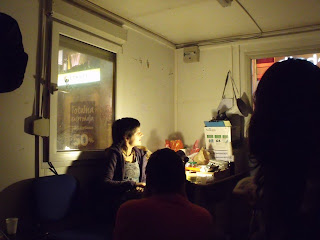
Protesting students having a drink after their "shift" in the container, pre-container demolition.
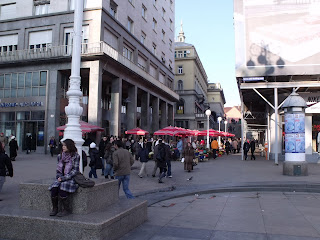
Back in the day women used to come to Cvijetni Trg (Flower Square) to sell their, well, obviously, flowers. There were hand pumps for water and a beautiful, small Orthodox church flanks the square to the north. Pedestrian corridors radiate from the square, connecting to Ilica Ulica, a big commercial street and tram line while a network of small passages connect under and through the surrounding buildings. The “sun”, a huge metal ball representing the center of the universe sits in the middle of one connector pedestrian street and small specks of metal have been cemented onto buildings around town representing, to scale, the universe in Zagreb. Mercury is in the old upper town. Pluto is beyond the last tram stop to the west. This central square is marked as such both symbolically with the “sun” (see image below) and physically in its proximity to almost everything in downtown Zagreb. There used to be large, old trees but at some point a “modernization” effort removed the old hand pumps, newly paved the square and took down the old trees. People protested but their voices seemed to resonate like TV fuzz in the background and were easily tuned out. Numerous people have said that the “renovation” of Flower Square was the biggest architectural mistake in Zagreb (this is saying a lot in a town that destroyed 500 year old fortress walls surrounding the cathedral to create open space that turned into a car turn-around and demolished a medieval neighborhood so that they could move the market from the main square to someplace less dignified and fitting of the provincial Dolac market). An old factory sat on one edge of the square where chairs are set up in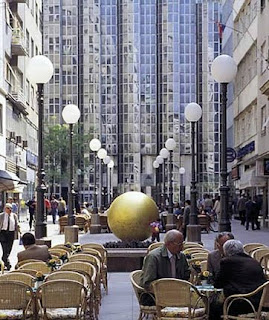 thick clusters like hundreds of living room arrangements gathered around tiny tables for coffee and beer. The building was over a hundred years old when it was sold to a private developer with visions of shopping malls dancing in his head. The omnipresent shopping malls in Zagreb feel like the shopping malls in LA, Berlin or Milwaukee – they have the same stores and the same layout, facing inward along the “streets” of tile and escalators that create cloned indoor cities across the world with the result of homogenizing people and stripping away any distinctive character that a place may have. Since it was just reported that over 300,000 Croatians are unemployed, I am not sure who will be patronizing this new mall. Zagreb citizens protested and while the discussion went on in city offices, the factory was bulldozed and VIP Telecommunications was sold the advertising space on the scaffolding surrounding the new pit which they promptly covered in a flashy poster of a woman’s legs, 25 meters tall, waltzing with her cell phone. You’d think that the citizens of Zagreb may be deterred or discouraged but they remain ever vigilant because they know that the buck doesn’t stop with honored public space and traditional livelihoods like the flower vendors. The 150 year old factory was simply a remnant of a socialist history that the powers-that-be in Zagreb would rather bulldoze into the past. This is how Croatian cities are formed and reformed, you see. Politics and influence are constantly flexing, responding, defining themselves and redefining themselves. Last night I got into a conversation with a bunch of Croat friends about Coca-Cola versus Pepsi during which one friend gave me an animated lecture about the politics surrounding both brands and the soap box that you stand on when you chose to drink one over the other. Regardless of whether he had his facts straight about soda pop, every choice made in this country by Croatians is made to make or erase a point. And the situation of truth is relative. Drinking Pepsi is a statement against “fascist bastards” (according to this friend) and tearing down the old factory is a statement of progression into the modern capitalist world that Croatia is trying so hard to gain respect in (they are rushing the EU right now and they are trying to be the best darned European nation they can be). Well, I’ve got news for you, the powers-that-be in Zagreb: you can’t sell off your history and you can’t ignore the voices of the public because they own that land as well as those streets lined with cafes and stores. Those little conduits where the public musicians play guitars by the big “sun” – that belongs to them too.
 thick clusters like hundreds of living room arrangements gathered around tiny tables for coffee and beer. The building was over a hundred years old when it was sold to a private developer with visions of shopping malls dancing in his head. The omnipresent shopping malls in Zagreb feel like the shopping malls in LA, Berlin or Milwaukee – they have the same stores and the same layout, facing inward along the “streets” of tile and escalators that create cloned indoor cities across the world with the result of homogenizing people and stripping away any distinctive character that a place may have. Since it was just reported that over 300,000 Croatians are unemployed, I am not sure who will be patronizing this new mall. Zagreb citizens protested and while the discussion went on in city offices, the factory was bulldozed and VIP Telecommunications was sold the advertising space on the scaffolding surrounding the new pit which they promptly covered in a flashy poster of a woman’s legs, 25 meters tall, waltzing with her cell phone. You’d think that the citizens of Zagreb may be deterred or discouraged but they remain ever vigilant because they know that the buck doesn’t stop with honored public space and traditional livelihoods like the flower vendors. The 150 year old factory was simply a remnant of a socialist history that the powers-that-be in Zagreb would rather bulldoze into the past. This is how Croatian cities are formed and reformed, you see. Politics and influence are constantly flexing, responding, defining themselves and redefining themselves. Last night I got into a conversation with a bunch of Croat friends about Coca-Cola versus Pepsi during which one friend gave me an animated lecture about the politics surrounding both brands and the soap box that you stand on when you chose to drink one over the other. Regardless of whether he had his facts straight about soda pop, every choice made in this country by Croatians is made to make or erase a point. And the situation of truth is relative. Drinking Pepsi is a statement against “fascist bastards” (according to this friend) and tearing down the old factory is a statement of progression into the modern capitalist world that Croatia is trying so hard to gain respect in (they are rushing the EU right now and they are trying to be the best darned European nation they can be). Well, I’ve got news for you, the powers-that-be in Zagreb: you can’t sell off your history and you can’t ignore the voices of the public because they own that land as well as those streets lined with cafes and stores. Those little conduits where the public musicians play guitars by the big “sun” – that belongs to them too.
left: inside the container on a peaceful night.
But here’s the kicker. A week ago I went down to meet the boyfriend of a friend who is part of a student protest on Flower Square. The City didn’t stop at demolishing the factory. The developer decided to put in high-end condominiums and wanted private parking for his residents’ BMWs and Mercedes. He asked the city for a little favor – could he please have one small pedestrian street connected to Flower Square. He wants to put in a parking garage with close proximity to the condos. The City of Zagreb acquiesced, perhaps even willingly since I’m sure this developer is paying a pretty penny. Students and citizens set up “containers”, the box-like structures often put semi-permanently on construction sites. They filled the containers with protesters around the clock who smoked cigarettes, chatted and watched the police in their SmartCars zip around the square monitoring their activities. A British-Croatian girl had hunkered down for the long haul, in her sleeping bag, explaining to me that although the decision to turn this street into a private parking garage would go through a public process, the public really had no forum for participating in the discussion. These containers were their “letter to the Mayor”. They were their chance to stand at the microphone before Mayor and Council and be heard.
I left Zagreb to come to Vis for my research for a week. Sitting in the kitchen of my friend Dini, he turned on the television and to my horror, the national news showed the Special Police (in full riot gear) tearing down the containers and crawling over the edges into them to pull out the protesters like flopping fish from the ocean. It was dark and the entire scene looked like an overly dramatic movie. There are so many things I find uncomfortable/despicable about this situation. I am sad to predict that the reason the Special Police were used (at night, in large numbers) appears to be part of the manipulative drama that portrays the protesters in a dark and unruly light in an attempt to influence public opinion towards what seems to be another inevitable mistake in public space appropriation and use. This is just my hypothesis. But I don’t think it’ll work. I think the citizens of Zagreb know exactly what is happening. I don’t have my ear close enough to the ground to know if it will matter, if the majority of citizens will be apathetic, feel they don’t have any power, or see this as yet another inevitable case of corruption lining the pockets of the powerful… or whether the Croatian collective psychology that seems to find power when there is a reason to coalesce against something will continue to protest. I leave for Zagreb today. I’ll keep you updated.

left: the pedestrian street leading to the Trg (square) that is slated to become a parking garage.


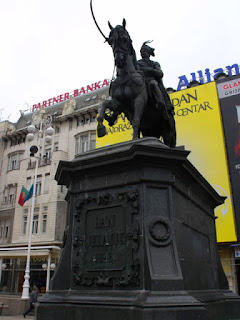


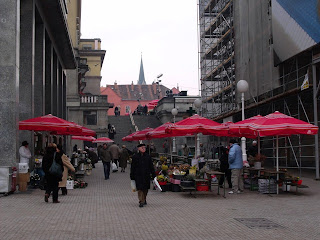 Images above: Giggling Croatian teenagers in the Trg; the staggered clock tower in the distance, the Ban in the center and the fountain in the foregroundpast the flower sellers, up the stairs to the Dolac market.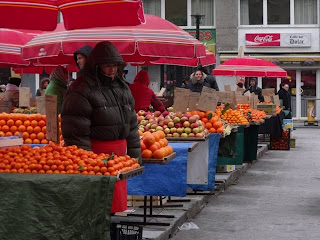
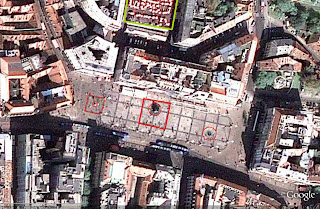
 Aerial below: Jelačić is in the center red square, the clock on the left/west side and the fountain on the right/east side. The green square is the Dolac market; the fountain on a cold day.